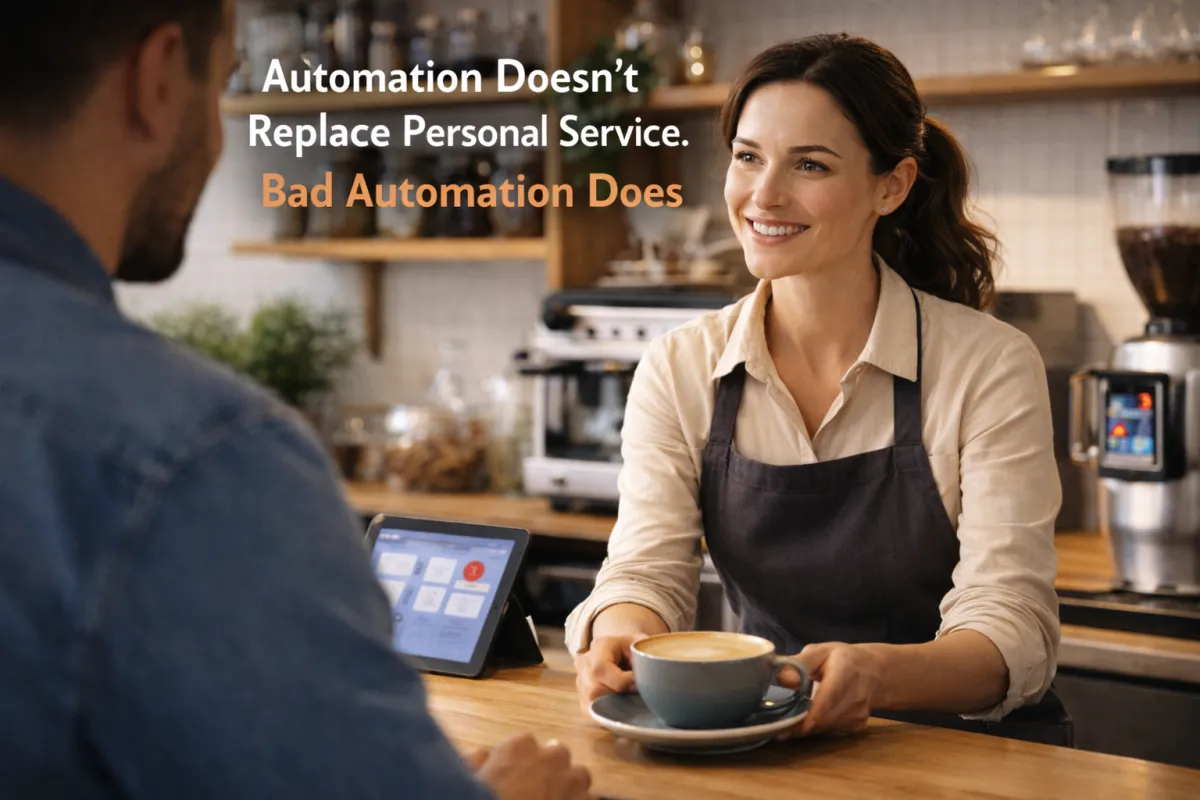
Automation Doesn’t Replace Personal Service. Bad Automation Does
Why poorly designed automation damages trust – and why good automation protects it
Automation is often blamed when customer experience starts to feel cold or impersonal.
Small businesses introduce automation to save time, improve follow-up, or create consistency. Yet many end up feeling that automation has done the opposite – distancing them from customers rather than improving service.
This leads to a common conclusion:
Automation replaces personal service.
In reality, automation does not replace personal service.
Bad automation does.
Understanding the difference is critical for any business using automated systems.
Why Automation Gets Blamed for Poor Customer Experience
Automation itself is neutral.
It simply carries out the instructions it has been given.
When automation damages customer experience, it is usually because it has been designed around:
Efficiency rather than understanding
Speed rather than relevance
Internal convenience rather than customer clarity
The issue is not the presence of automation – it is automation without context.
Customers Do Not Dislike Automation – They Dislike Confusion
Most customers are comfortable with automation when it:
Acknowledges their enquiry quickly
Explains what will happen next
Makes it easier to continue the conversation
Problems arise when automation:
Pretends to be personal but clearly isn’t
Sends irrelevant or repetitive messages
Blocks access to a real person
In these cases, customers feel ignored rather than supported.
Good automation creates clarity.
Bad automation creates friction.
Common Automation Mistakes in Small Businesses
Poor automation tends to follow predictable patterns.
The most common automation mistakes include:
Automating conversations before understanding the customer journey
Using one generic message for every enquiry
Removing all human involvement too early
Prioritising volume over relevance
These mistakes lead to automation that feels intrusive or dismissive.
From the customer’s perspective, the business no longer feels attentive – it feels distant.
Automation Should Support Human Service, Not Replace It
Effective automation has a very specific role.
It should handle tasks that:
Are repetitive
Require consistency
Do not need emotional judgement
Examples include:
Acknowledging enquiries
Sending confirmations and reminders
Routing messages to the right place
This allows people to focus on what automation cannot do well:
Listening
Understanding nuance
Building trust
When automation removes friction, personal service improves.
When automation removes people entirely, personal service disappears.
The Difference Between Helpful and Harmful Automation
A simple way to evaluate automation is to ask:
Does this make the customer feel clearer or more confused?
Helpful automation:
Sets expectations clearly
Uses simple, human language
Reflects where the customer actually is in their journey
Harmful automation:
Sends messages without relevance
Forces customers into rigid paths
Ignores what the customer has already said
Why Bad Automation Feels Worse Than No Automation
When automation is poorly designed, it doesn’t just fail quietly.
It actively damages trust.
Customers often interpret bad automation as:
A lack of care
A business hiding behind systems
A sign that their enquiry is not important
This is why some businesses remove automation entirely after a negative experience.
Ironically, well-designed automation often feels more personal than manual follow-up, because it is timely, consistent, and clear.
Automation Is a Design Problem, Not a Technology Problem
When automation fails, the instinct is to blame the tool.
In practice, the failure usually occurred earlier:
The customer journey was never mapped
Decision points were unclear
Human involvement was removed too soon
Automation should reflect real customer behaviour, not idealised scenarios.
When automation is designed with empathy and context, it strengthens personal service rather than replacing it. When it comes to Automation, it's a huge learning curve and weve realised that the initial learning isnt the problem, its testing automations and realising when its not behaving the way you expected and thats where the real learning curve comes. We ran a workshop on HighLevel's Automations & Workflows, and you can watch it for free by clicking here.
Key Takeaway
Automation does not replace personal service.
What replaces personal service is:
Automation without context
Automation without empathy
Automation without human oversight
When automation is designed to support people rather than replace them, it quietly improves customer experience – often without customers even noticing.
And that is exactly how good automation should feel.
Written by Atticus Mills - MarketerM8 Implementor and AI Implementation Specialist at AI-M8

