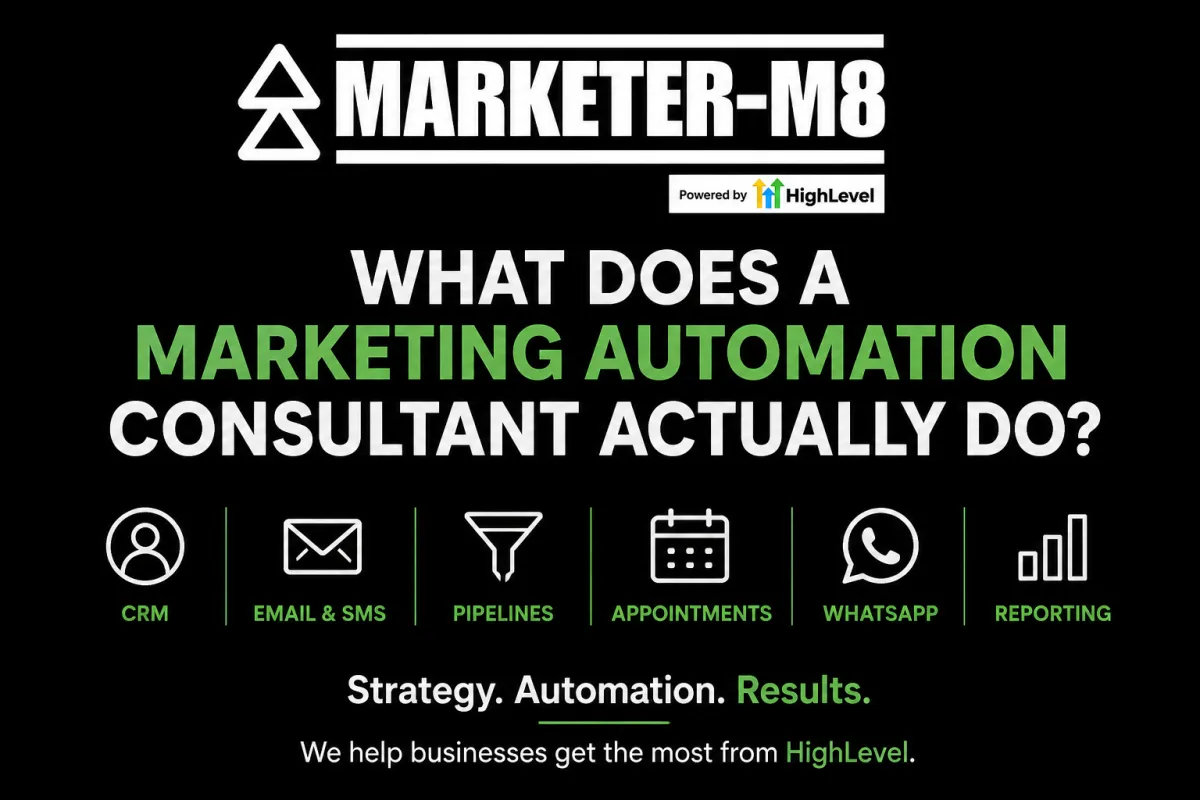
What Does a Marketing Automation Consultant Actually Do?
Marketing automation software has become incredibly powerful.
A modern platform such as HighLevel can manage your CRM, send emails and SMS, handle WhatsApp conversations, book appointments, manage sales pipelines, collect reviews, power websites and funnels, and even use AI to answer telephone calls.
But having access to all that technology doesn't necessarily mean you know what to do with it.
That's where a marketing automation consultant comes in.
A good marketing automation consultant shouldn't simply know which buttons to press. They should understand your business, your marketing and your sales processes, identify where opportunities are being lost, and then work out how automation can improve them.
At MarketerM8, that's an important distinction.
We're a HighLevel agency and software provider, but we're also very much a people business.
MarketerM8 isn't a faceless organisation where you get passed between departments. When you work with us, you're working with Julian and Atticus Mills, and over time we get to know your business inside and out.
What is a marketing automation consultant?
A marketing automation consultant helps a business work out where technology can improve its marketing, sales and customer communication.
The important words there are "work out".
Building an automation is often the easy part.
The harder part is deciding what should be automated in the first place.
Imagine someone completes an enquiry form on your website.
You could simply send them an automatic email saying:
Thanks for your enquiry. Someone will be in touch.
Technically, that's marketing automation.
But is it the best process?
Perhaps that enquiry should immediately enter your CRM, create an opportunity in your sales pipeline, notify the appropriate person, send a personalised acknowledgement and offer the prospect an opportunity to book an appointment.
And what happens if nobody manages to speak to them?
Should another email be sent? Would SMS be more appropriate? Should somebody be given a task to call them? At what point should the follow-up stop?
HighLevel can handle the technology.
The job of a marketing automation consultant is to work out what should happen and why.
Marketing automation consultant vs marketing automation technician
We think there's an important distinction between a marketing automation consultant and a technician.
A marketing automation technician is typically focused on building what you've asked for.
You say:
"Build me a workflow that sends three emails."
They build the workflow.
There's absolutely nothing wrong with that. Sometimes that's precisely what you need.
But a marketing automation consultant should be asking questions first.
Why are we sending those emails?
Who are they going to?
What happened immediately before this?
What do we want the prospect to do next?
What happens if they reply?
What happens if they don't?
Would SMS or WhatsApp be more appropriate at some point?
Does somebody need to make a telephone call?
How will we know whether the automation is actually working?
That's the difference between automating tasks and improving a marketing system.
You tell us what you want to achieve. We translate that into HighLevel
This is particularly important to the way we work at MarketerM8.
Julian Mills is a specialist marketing automation strategist.
You don't need to come to Julian knowing which HighLevel workflows, triggers, pipelines, custom fields or integrations you need.
In fact, we'd rather you didn't.
Instead, tell us about your business.
Tell us what you're trying to achieve.
Tell us what's currently frustrating you.
Tell us where you think leads are being lost, where staff are spending too much time doing repetitive work, or where customers aren't getting the experience you'd like them to have.
Julian's role is to understand those business and marketing requirements and translate them into a practical HighLevel strategy.
Put simply:
You tell us what you want the business to achieve. We work out how HighLevel can help make it happen.
Julian and Atticus can then turn that strategy into the CRM structure, pipelines, workflows, communications, integrations and automations required to make it work.
That's quite different from simply asking somebody to build a workflow.
Our experience with CRM and marketing automation
Our experience with CRM and marketing automation goes back to 2009, when Julian first started working with Infusionsoft, long before HighLevel existed.
Julian came to CRM and automation from a direct response marketing background, so the focus was never simply on learning software. It was about using technology to improve marketing, follow-up and sales.
In one early project, CRM and marketing automation formed part of a direct response operation that generated around £500,000 in six months selling a £20 information product.
Julian subsequently spent many years working with Infusionsoft and later Keap.
Atticus Mills started working with CRM systems and marketing automation in 2022, and has become increasingly involved in the practical implementation and technical side of what we do.
Today, Julian and Atticus work together through MarketerM8, using HighLevel as our primary CRM, marketing automation and AI platform.
That gives us a useful combination.
Julian's particular strength is understanding the marketing strategy and translating business requirements into what HighLevel needs to do.
Atticus works alongside Julian on the CRM, automation and implementation side, helping turn those ideas into working systems.
The technology has changed enormously since Julian first started working with automation in 2009, particularly with the arrival of AI.
But one principle hasn't:
Start with the marketing and the business process. Then use the technology to make it happen.
Marketing automation isn't a one-off transaction
This is another important part of how we work.
When a business approaches MarketerM8 for marketing automation help, we don't see it as simply a one-off transaction where we build a few workflows, hand them over and disappear.
To use HighLevel effectively, we need to understand how your business actually works.
That means getting to know your products and services, how you generate enquiries, how your sales process works, how your team operates, what happens when somebody becomes a customer and where opportunities are currently being missed.
Over time, Julian and Atticus get to know your business inside and out.
And that's valuable.
The better we understand your business, the easier it becomes for us to spot other opportunities where HighLevel could help.
You might initially come to us because you want to improve the follow-up of new enquiries.
Once we understand the business, we might identify opportunities around customer reactivation, appointment reminders, reviews, WhatsApp, sales pipelines, AI receptionists or another process that you hadn't originally thought about automating.
Your requirements won't stand still either.
Your business changes.
Your customers change.
HighLevel changes.
New functionality becomes available, particularly around AI.
Something that wasn't practical or possible six months ago might suddenly become achievable.
That's why we see marketing automation as an ongoing process of improvement rather than a single transaction.
Our objective is to make sure you're continually getting as much value as possible from HighLevel.
What can a marketing automation consultant help with?
The precise work varies enormously from one business to another.
Some businesses come to us because they barely have a CRM.
Others already have thousands of contacts and numerous systems, but nothing talks to anything else.
Here are some of the areas we commonly look at.
Lead capture and follow-up
What happens when someone makes an enquiry?
One of the simplest uses of marketing automation is making sure a lead doesn't disappear because somebody forgot to follow it up.
A CRM can capture the enquiry, notify your team, create an opportunity and start appropriate follow-up automatically.
But the important part is deciding what that follow-up should look like.
Should somebody call immediately?
Should the prospect receive an email?
Should they be offered an appointment?
What should happen if they don't respond?
Those are the questions we want to answer before we start building workflows.
CRM and sales pipelines
A CRM shouldn't simply be an electronic address book.
It should help you understand where prospects are in your sales process and what needs to happen next.
Automation can move opportunities through pipelines, create tasks, trigger communications and alert people when action is required.
A well-designed CRM should help your team see what's happening rather than create another administrative burden.
Email marketing automation
Email remains one of the most useful and cost-effective marketing channels available.
Automation can be used for lead nurturing, customer onboarding, reminders, reactivation campaigns, review requests and numerous other processes.
But sending more emails isn't necessarily the answer.
The objective is to send the right communication at the right point in the customer journey.
SMS and WhatsApp automation
Sometimes email is appropriate. Sometimes an SMS or WhatsApp message will get a much better response.
The important thing is that these channels don't need to operate independently.
With the right system, email, SMS, WhatsApp and telephone calls can all form part of the same customer journey.
We also don't believe in using a particular channel simply because the software allows it.
For example, WhatsApp can be incredibly effective, but that doesn't mean every message should be sent through WhatsApp.
Sometimes email is the better and considerably cheaper option.
Good marketing automation is about choosing the right channel for the right message.
Appointment booking
Marketing automation can allow prospects to book appointments directly into the appropriate calendar and then automatically send confirmations and reminders.
It can also trigger different follow-up depending on whether someone books, attends, cancels or doesn't turn up.
A booking isn't an isolated event.
What happened before the appointment and what happens afterwards can be just as important.
Customer reactivation
This is one of our favourite areas of marketing automation.
Many businesses are sitting on databases containing hundreds or thousands of previous customers and old enquiries.
Instead of continually spending money generating new leads, sometimes the fastest opportunity is simply following up the people you already know.
We've seen relatively straightforward database reactivation campaigns generate substantial additional revenue.
The technology behind these campaigns is rarely the difficult part.
The real questions are who should be contacted, what should be offered, what should be said and what should happen when somebody responds.
Reviews and reputation
Once a customer has bought from you, automation can help generate reviews and referrals.
Rather than relying on staff remembering to ask every customer, the request can become part of the process.
The same principle can be applied to customer feedback.
AI receptionists and conversational AI
This is one of the fastest-moving areas we're currently working with.
An AI receptionist can answer calls, deal with common questions, collect information, book appointments and update the CRM.
But again, the interesting part isn't simply the AI voice.
It's what happens to the information after the telephone call.
Does it create an opportunity?
Does it book an appointment?
Does somebody need to follow up?
Should an email or WhatsApp message be sent?
That's where connecting AI to the wider marketing automation system becomes particularly powerful.
We also believe businesses should be transparent when using an AI receptionist. We recommend telling callers at the beginning of the conversation that they're speaking to an AI receptionist working on behalf of the business.
The objective isn't to trick somebody into believing they're talking to a human.
It's to use AI intelligently to provide a faster and better service.
Why we use HighLevel
Today, HighLevel is our preferred platform for implementing CRM and marketing automation.
One of the reasons is that so many of the tools we need are available within the same ecosystem.
Instead of having one system for your CRM, another for email, another for SMS, another for calendars, another for funnels, another for WhatsApp and another for AI, much of it can be brought together within HighLevel.
And HighLevel is no longer a small or niche CRM platform.
HighLevel co-founder Shaun Clark has said that HighLevel is now the second-largest CRM in the world by users, behind only Salesforce, and that the company is growing at more than 50% year-on-year.
Those are Shaun Clark's own figures rather than independently verified CRM market-share statistics, but they give an indication of the scale HighLevel has now reached. HighLevel itself says the platform was powering 2.2 million businesses by 2025.
For us, though, the attraction isn't simply HighLevel's size.
It's what we can do with it for our clients.
A business can bring its CRM, sales pipelines, email, SMS, WhatsApp, calendars, websites, funnels, payments, reputation management and increasingly AI into a much more connected system.
That's also why we've built MarketerM8 around HighLevel.
Businesses can access the HighLevel platform through MarketerM8, with Julian and Atticus providing the marketing automation strategy, implementation, training and ongoing help where required.
But that doesn't mean every business should switch on every feature or automate everything simply because HighLevel can do it.
Quite the opposite.
A good implementation should start with the processes that will make the biggest difference to the business.
The technology is HighLevel. Our job is to help you work out how to get the most from it.
Software alone or software plus consultancy?
This is an important question when choosing a marketing automation platform.
Some businesses simply need the software.
They already know what they want to build, have somebody internally who can take responsibility for it and are comfortable implementing it themselves.
That's fine.
Other businesses want help.
They might need someone to look at their existing marketing and sales process, identify the opportunities and help turn those ideas into a working system.
At MarketerM8, we can provide HighLevel software together with marketing automation consultancy, implementation and training where required.
That's why we're more than simply a software reseller.
We're a UK-based HighLevel agency with marketing automation strategy, consultancy and implementation expertise.
And importantly, you know who you're dealing with.
You're working with Julian and Atticus, not an anonymous support department.
Do you need a marketing automation consultant?
Not necessarily.
If you've got a simple requirement and you're comfortable configuring the software yourself, you may not need a consultant at all.
But consultancy becomes particularly useful when you find yourself asking questions such as:
We've bought the software, but where do we start?
What should we automate first?
Why aren't our leads being followed up properly?
How do we bring several different systems together?
How should we structure our CRM?
Where could AI genuinely help the business?
How can we get more value from our existing customer database?
How do we get our team actually using the system?
Those aren't really software questions.
They're business, marketing and process questions.
The software is simply how we implement the answers.
What should you look for in a marketing automation consultant?
We'd look beyond software certifications.
Knowing how a platform works is obviously important, but we'd also want to know whether the consultant understands marketing and business.
Ask about their experience.
Can they give you examples of problems they've solved?
Do they ask questions about your business before recommending technology?
Do they understand lead generation, follow-up and conversion?
Can they explain things without disappearing into technical jargon?
Will they take the time to understand how your business actually works?
And perhaps most importantly:
Are they trying to automate your existing mess, or are they helping you improve the process first?
Automating a poor process simply allows you to do the wrong thing faster.
Marketing automation is changing because of AI
This is where things are becoming particularly interesting.
For years, marketing automation largely meant:
If this happens → do that.
For example:
Form submitted → send email.
AI introduces another layer.
Systems can increasingly interpret conversations, understand intent, summarise information, generate appropriate responses and help determine what should happen next.
We're seeing this already with AI receptionists, conversational AI and the growing range of AI tools available within HighLevel.
We don't think this makes marketing automation consultants redundant.
If anything, it makes the strategy more important.
Businesses now have far more things they can automate.
The question becomes:
Which things should they automate?
And that's exactly where understanding the business becomes so important.
What about starting your own HighLevel agency?
There's another side to what we do at MarketerM8.
Some people aren't looking for marketing automation software for their own business. They want to build a business providing HighLevel to other businesses.
We help people who want to start their own HighLevel agency through our HighLevel affiliate relationship.
This is different from supporting established HighLevel agencies that already have the software.
Our focus is on people who want to become a HighLevel agency, sign up for HighLevel through our affiliate and get help as they begin their journey.
Julian and Atticus can help you understand the platform, learn how the agency model works and start putting the foundations in place to build your own HighLevel agency and client base.
Marketing automation should start with marketing
If there's one principle that has remained consistent throughout our experience with CRM and marketing automation, it's this:
Don't start with the software.
Start with the customer and the business.
Look at how people discover you, what happens when they enquire, how your team follows them up, why people buy, why they don't buy and what happens after they become a customer.
Then ask where technology, automation and AI can improve that journey.
That's what we believe a marketing automation consultant should really do.
It's why Julian's role as a marketing automation strategist is so important.
And it's why, when you work with MarketerM8, Julian and Atticus want to understand your business rather than simply sell you another piece of software.
You tell us what you want to achieve. We work out how HighLevel can help make it happen.
Want to explore what you could automate?
If you're considering HighLevel or want to improve the way your existing marketing and sales processes work, let's start with a conversation about your business.
Julian and Atticus can look at where leads are coming from, how they're currently being followed up, what you're trying to achieve and where CRM, marketing automation or AI could make the biggest difference.
Book a discovery call with me, and let's explore what's possible.

