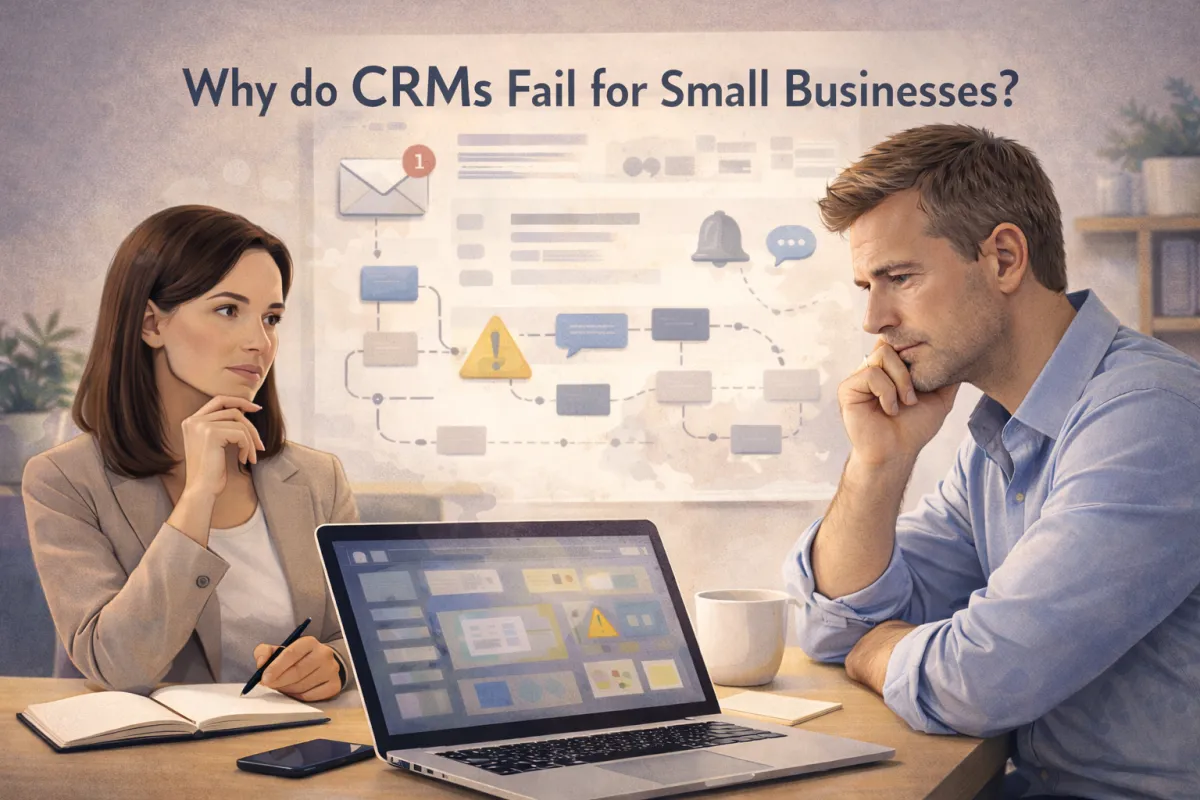
Why Most CRMs Fail Inside Small Businesses
The real reasons CRM systems struggle with adoption, accuracy, and results
Customer Relationship Management software is widely promoted as essential for small businesses. Yet in practice, many CRMs fail to deliver meaningful results once they are implemented.
Business owners we speak to often describe the same experience: the CRM is purchased with good intentions, used briefly, and then slowly ignored.
This leads to a common belief that CRMs do not work for small businesses. In reality, most CRM failures are not caused by the software itself, but by how CRM systems are introduced, structured, and used day to day.
CRMs Are Implemented to Fix Problems They Were Never Designed to Solve
One of the main reasons CRMs fail inside small businesses is misaligned expectations.
CRMs are often purchased to fix issues such as:
Leads not being followed up
Enquiries being missed
Poor visibility of sales activity
Disorganised customer communication
These are not software problems.
They are process problems.
When a CRM is implemented before a basic stratagy is defined, the system has no stable structure to support. The CRM simply mirrors the existing chaos in digital form.
CRM Software Is Often Too Complex for Small Business Reality
Popular CRM platforms such as HubSpot and Monday.com are built to serve a wide range of organisations, including large sales teams and enterprise environments.
Small businesses, however, usually operate very differently.
Typical small business realities include:
One person handling sales, admin, and follow-up
Informal conversations rather than structured sales stages
Changing offers, pricing, and processes
When CRM systems introduce:
Excessive data fields
Overly detailed pipelines
Features that are never used
…the system becomes a barrier rather than a support.
This is a major contributor to CRM adoption failure in small businesses.
CRM Data Entry Feels Like Extra Work, So It Gets Avoided
A CRM system is only useful if the data inside it is accurate and up to date.
In many small businesses, CRM data entry:
Happens inconsistently
Is delayed until the end of the day or week
Is skipped altogether when things get busy
This happens because updating the CRM is often perceived as separate from real work, rather than part of it.
Once CRM data becomes unreliable, trust in the system disappears.
When trust is lost, usage drops.
When usage drops, the CRM effectively fails.
CRMs Fail When They Don’t Reflect How Customers Communicate
Modern customer communication happens across multiple channels:
Email
Phone calls
SMS
Social messages
WhatsApp
Small businesses often respond wherever the enquiry arrives, using whatever tool is fastest at the time.
When a CRM:
Does not automatically capture conversations
Requires manual updates
Splits communication across different systems
…it fails to become a single source of truth.
This disconnect is a core reason why CRM systems fail in practice, even when they look good in demos. We dive into the conversation view (where all the communication between the business and the enquiries is) in our free HighLevel Database Management workshop, which you can watch for free on YouTube by clicking here.
Lack of Ownership Is a Hidden Cause of CRM Failure
In many small businesses, no one is clearly responsible for the CRM.
This leads to:
No agreed standards
No regular data cleanup
No accountability for accuracy
When everyone owns the CRM, no one truly owns it. When we work with new clients, one of our first requirements is that the business has a HighLevel Champion, a member of the team who takes the reins of the software and owns it. Or we have a Premium pricing plan where a member of the MarketerM8 team will be a designated account manager for your HighLevel account. If you're interested in this, you can view our pricing plans by clicking the following link: https://www.marketerm8.com/pricing
Without ownership, CRM systems slowly degrade. Data becomes outdated, reports become unreliable, and the system loses credibility.
At that point, the CRM is still technically present, but operationally irrelevant.
CRMs Are Rarely Treated as Living Systems
Another key reason CRMs fail is that they are treated as one-time projects.
The pattern is familiar:
CRM is set up
Initial training takes place
The business evolves
The CRM stays the same
Small businesses change constantly.
Services evolve, customer journeys shift, and internal roles adapt.
When the CRM does not evolve alongside the business, it quickly feels restrictive and out of date. Staff then work around the system instead of within it.
The Root Cause of Most CRM Failures in Small Businesses
When you step back, most CRM failures share the same underlying cause.
CRMs fail when they are treated as:
A tool rather than a system
A database rather than a workflow
A setup task rather than an ongoing process
The failure is rarely technical.
It is behavioural and organisational.
This is why simply switching CRM platforms rarely fixes the problem.
Key Takeaway
Most CRMs do not fail because small businesses chose the wrong software.
They fail because:
Processes were unclear
Complexity outweighed usability
Daily behaviour was not considered
Ownership and structure were missing
Understanding why CRM systems fail in small businesses is the first step towards building one that actually works.
Written by Atticus Mills - MarketerM8 Implementor and AI Implementation Specialist atAI-M8

